
 Charles Ryan Sy
Choosing between a third-party logistics (3PL) warehouse and a fulfillment center depends on your business's storage, inventory management, and shipping needs. A 3PL warehouse in the Philippines is ideal for businesses that need space to store bulk inventory and manage stock before distribution. In contrast, a fulfillment center is better suited to businesses that regularly process customer orders and need help with picking, packing, and shipping products.
Although these services can overlap, they serve different purposes. Understanding their differences can help you manage logistics costs, streamline operations, and choose a solution that fits your business needs as it grows.
Key Takeaways: 3PL Warehousing vs. Fulfillment Centers
- A 3PL warehouse in the Philippines is best for businesses that need bulk inventory storage, stock management, and distribution to retailers, distributors, or other locations.
- An e-commerce fulfillment center in the Philippines is ideal for online sellers that need help processing customer orders, picking and packing products, and coordinating parcel shipping.
- The main difference is their primary function: 3PL warehousing focuses on storing and managing inventory, while fulfillment centers prioritize preparing individual customer orders for delivery.
- Many online sellers outsource fulfillment at around 100 to 150 orders a day, or before a big sale event, when packing in-house starts to delay dispatch.
- 3PL warehousing costs typically depend on storage space, storage duration, inventory handling, and stock movement. Fulfillment costs may cover picking, packing, packaging materials, and shipping, while storage, returns processing, and additional handling may be charged separately. Returns and storage for slow-moving stock are the costs sellers most often leave out.
- Some logistics providers offer both services, allowing businesses to store bulk inventory and fulfill customer orders through one provider.
- Choose the right solution based on your inventory volume, order frequency, sales channels, delivery requirements, and total logistics costs. Always confirm the provider's service coverage and fees before signing an agreement.
Table of Contents
- What Is a 3PL Warehouse in the Philippines?
- What Is a Fulfillment Center?
- 3PL Warehouse vs. Fulfillment Center: Key Differences
- How Much Does 3PL Warehousing or Fulfillment Cost in the Philippines?
- Which Option Is Right for Your Business?
- How to Choose a Logistics Provider in the Philippines
- Find the Right Warehousing Solution for Your Business
- Frequently Asked Questions About 3PL Warehousing and Fulfillment Centers
What Is a 3PL Warehouse in the Philippines?
A 3PL warehouse in the Philippines can be useful for importers, wholesalers, manufacturers, retailers, and e-commerce businesses that need extra storage space or help managing their stock. Depending on the provider, services may include receiving shipments, monitoring inventory levels, storing bulk goods, preparing stock for distribution, and coordinating deliveries.
Businesses importing products from overseas may also need to plan for shipping, customs clearance, and final delivery before their inventory reaches a warehouse. This complete process of importing from China to the Philippines explains the key steps involved.
For example, a local retailer importing products from China might not have enough space to store an entire shipment. Renting a warehouse and hiring staff could also be costly, especially for a growing business. Working with a 3PL provider gives the retailer a place to keep its inventory and access stock when needed, without having to manage a warehouse on its own.
What Services Does a 3PL Warehouse Offer?
The exact services depend on the provider, but common offerings include:
- Inventory storage: Keeps products in a designated facility until they are needed.
- Stock management: Tracks inventory levels, stock movements, and available quantities.
- Receiving and inspection: Records incoming goods and checks for visible damage or discrepancies, depending on the agreed service.
- Order preparation: Organizes products for bulk dispatch, stock transfers, or distribution.
- Transportation coordination: Arranges deliveries to retailers, distributors, or other destinations when included in the service.
- Import logistics support: May coordinate with freight forwarders and licensed customs brokers to help move imported goods through the supply chain.
This setup works well for businesses that need reliable storage and organized inventory movement. It can also help companies manage fluctuating stock levels without investing in their own warehouse facilities.
What Is a Fulfillment Center?
Once a customer places an order online, there are several steps before the package reaches their doorstep. The product needs to be located, packed, labeled, and handed over to a courier. A fulfillment center handles these steps, helping online sellers keep orders moving without packing every parcel themselves.
For businesses selling through online stores, marketplaces, and other digital channels, an ecommerce fulfillment center in the Philippines focuses on preparing customer orders for accurate and efficient delivery.
Consider an online clothing shop that needs to process dozens of orders within a few hours. Orders may come in one after another, with customers requesting different sizes, colors, and styles. The fulfillment team picks each item, checks it against the order, packs it for shipping, and prepares it for courier pickup. This helps the seller manage a busy order queue without having to handle every package personally.
What Services Does a Fulfillment Center Offer?
Fulfillment centers commonly provide:
- Inventory receiving and storage: Accepts products and records available stock.
- Order processing: Receives orders through connected sales channels or manual submission.
- Picking and packing: Selects the correct items and prepares them for shipment.
- Shipping coordination: Arranges parcel dispatch through available courier or delivery partners.
- Returns handling: Receives returned items, inspects them, and updates inventory according to agreed procedures.
- Order tracking and reporting: Provides visibility into order status and inventory levels when supported by the provider's system.
Fulfillment centers prioritize efficient order processing. This makes them a practical option for online businesses that want to ship orders consistently without managing their own packing and dispatch operations.
3PL Warehouse vs. Fulfillment Center: Key Differences
The main difference lies in their primary purpose. Traditional 3PL warehousing focuses on inventory storage and the movement of goods through the supply chain. Fulfillment centers focus on preparing individual customer orders for delivery.
However, these services are not mutually exclusive. Many logistics providers offer both warehousing and order fulfillment.
| Feature | 3PL Warehouse | Fulfillment Center |
|---|---|---|
| Main purpose | Store and manage products in a designated space | Process customer orders and prepare them for delivery |
| Typical customers | Importers, wholesalers, distributors, and retailers | E-commerce stores and online sellers |
| Inventory handling | Manages bulk stock, pallets, cartons, and inventory levels | Stores products for quick picking and order processing |
| Order processing | Often handles bulk orders and shipments to businesses | Picks and packs individual customer orders |
| Shipping | Coordinates bulk deliveries and distribution | Prepares parcels for courier pickup and last-mile delivery |
| Returns management | May handle returned inventory and restocking | May process customer returns, exchanges, and restocking |
| Common pricing factors | Storage space, handling, inventory movement, and distribution | Storage, picking, packing, packaging, shipping, and returns |
Note: These distinctions are general guidelines rather than strict rules. Some fulfillment centers handle wholesale orders, while some 3PL warehouses offer complete e-commerce fulfillment. Check the provider's actual service coverage before making a decision.
How Much Does 3PL Warehousing or Fulfillment Cost in the Philippines?
There is no single rate that applies to every business. Your total logistics costs depend on how much inventory you store, how frequently goods move, how many orders you process, and which services your provider includes.
Warehousing and fulfillment also use different pricing structures. A warehouse may charge primarily for storage and inventory handling, while fulfillment costs often depend on order volume, package size, and the work required to prepare each shipment.
Typical 3PL Warehousing Costs
Warehousing charges generally depend on the amount of space your inventory occupies and how long it remains in storage. Providers may calculate storage fees using pallet positions, floor space, cubic meters, or another agreed measurement.
Other potential charges include:
- Inbound handling: Receiving, unloading, counting, and recording incoming inventory.
- Outbound handling: Preparing bulk stock for collection or delivery.
- Additional services: Labeling, repacking, inventory reporting, and transportation coordination.
Businesses storing large quantities of goods should ask about minimum monthly charges, storage duration, handling rates, and any fees that apply when stock enters or leaves the facility.
Before requesting a quotation, prepare details about your expected inventory volume, shipment frequency, storage requirements, and distribution destinations. If you're importing inventory from China, you can use a shipping calculator to estimate freight costs separately and account for them in your overall logistics budget.
Import costs can also include customs duties and taxes, which add to the total amount you need to budget for your inventory. When shipping smaller quantities through less-than-container-load (LCL) services, understanding these charges can help you estimate your total import expenses more accurately.
Related: Customs Duties and Taxes on LCL Shipments to the Philippines
Fulfillment Fees in the Philippines: What Affects the Cost?
Fulfillment fees in the Philippines vary depending on package size, order volume, storage requirements, and the services included in the provider's agreement. Rather than relying on a single rate, businesses should compare the full cost of preparing and shipping orders.
Many providers publish a per-order fee that rises with package size, from small pouches to large boxes and bulky items. That fee is usually only part of the bill: a monthly minimum or storage charge, system fees and value-added services are often added on top. For an example of how a published fee list is laid out, see the fees on StratQuad's fulfillment page.
Common factors that affect fulfillment costs include:
- Storage: Charges may depend on the amount of warehouse space your inventory occupies and how long it remains in storage. Slow-moving stock keeps adding storage costs every month it stays on the shelf.
- Picking and packing: Providers may charge for retrieving products, checking order details, and preparing parcels for shipment.
- Packaging materials: Boxes, mailers, bubble wrap, labels, and other supplies may be included in the service or billed separately.
- Courier shipping: Delivery fees depend on parcel dimensions, weight, destination, and the courier service selected.
- Returns processing: Receiving returned items, inspecting products, and updating inventory may incur additional charges. Failed deliveries, return-to-sender (RTS) parcels and customer returns all fall here.
- Additional handling: Labeling, bundling, special packaging, and other value-added services may increase the total cost.
- System and account fees: Some providers may charge for inventory software, sales-channel integrations, or additional connected stores.
- Taxes and VAT: Check whether quoted fulfillment fees include applicable value-added tax (VAT) or whether it will be added to your invoice.
The per-order fulfillment fee does not necessarily cover every logistics expense. Before choosing a provider, ask which services are included, whether minimum order or storage commitments apply, and how additional charges are calculated. Ask specifically how returns are graded and restocked, and what you will pay to store items that sell slowly.
Request an itemized quotation based on your expected monthly order volume, average parcel size, storage needs, and delivery destinations. Confirm whether quoted rates include applicable taxes so you can compare the total cost accurately.
Which Option Is Right for Your Business?
The best choice depends on your inventory volume, order frequency, sales channels, and delivery requirements. Understanding how your business operates can help you identify which services you need.
When Is It Time to Outsource Fulfillment?
For many online sellers, the tipping point comes at around 100 to 150 orders a day, or when a big sale event such as 9.9 or 11.11 causes a sudden spike. At that volume, founders can end up spending 4 to 6 hours a day picking, packing and printing waybills instead of planning inventory and growing the business.
Late dispatch has a direct cost on marketplaces. Orders that ship late can lead to late-shipment penalties, automatic cancellations and lower shop ratings.
Choose a 3PL Warehouse for Bulk Storage and Distribution
A 3PL warehouse may be the better choice if your business imports or manufactures products in large quantities and needs a place to store them before distribution.
Consider this option if you:
- Import products from China or other countries.
- Supply goods to retailers, distributors, or resellers.
- Need pallet storage or space for bulk inventory.
- Distribute stock to multiple branches or business locations.
- Want to outsource warehouse operations instead of managing your own facility.
For instance, a wholesaler importing household goods may receive a large shipment but sell the inventory gradually to different retailers. A 3PL provider can store the products and release stock as orders arrive.
Businesses with international shipments may also benefit from a provider that coordinates with freight forwarders and licensed customs brokers. If you need support moving goods from overseas suppliers, explore available importing services from China to the Philippines alongside your warehousing options.
Choose a Fulfillment Center for Frequent Online Orders
A fulfillment center is generally better suited to businesses that sell directly to customers and regularly process individual orders.
Consider this option if you:
- Operate an online store or sell through e-commerce marketplaces.
- Receive multiple customer orders each day.
- Need help picking and packing products.
- Want to outsource parcel preparation and courier coordination.
- Need inventory systems that connect with your sales platforms.
For example, a skincare brand selling through its website and online marketplaces may need to prepare numerous small orders daily. A fulfillment partner can manage packing and dispatch, allowing the business to focus on marketing, product development, and customer service.
Before signing an agreement, check which sales platforms the provider supports, how quickly orders are processed, and how returns and inventory discrepancies are handled.
Consider a Provider That Offers Both Services
Your business may need bulk storage and customer order fulfillment at the same time. In that case, choosing a provider that offers both services could simplify your logistics operations.
An integrated provider can receive imported inventory, store products, track stock levels, and fulfill customer orders as they arrive. This arrangement may reduce the need to coordinate multiple service providers, although the overall cost depends on the provider's capabilities and pricing.
It is worth comparing integrated services with separate providers to determine which arrangement offers the best balance of cost, flexibility, and operational control.
How to Choose a Logistics Provider in the Philippines
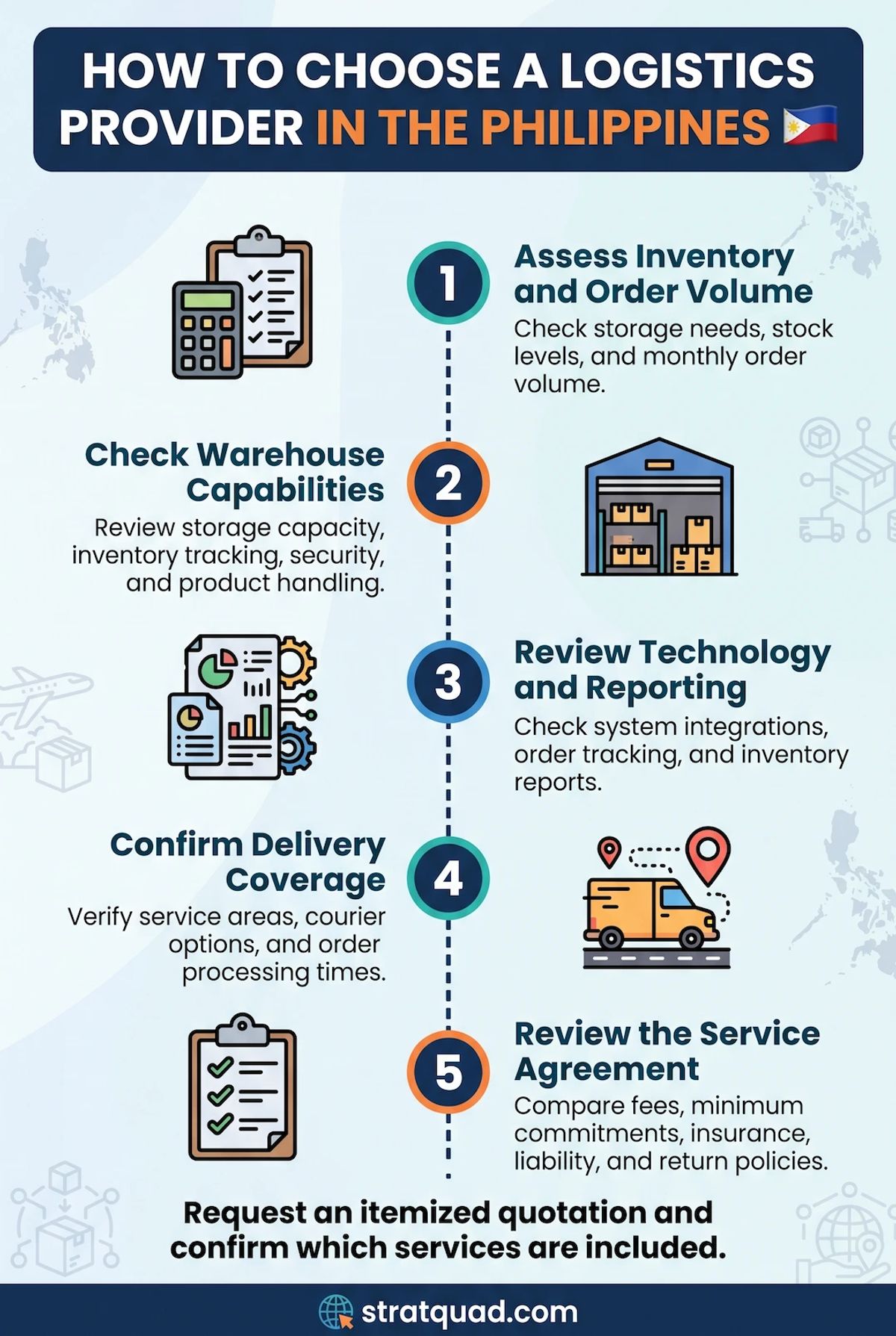
Once you know which services your business needs, compare potential providers based on their facilities, systems, pricing, and service agreements.
Assess Your Inventory and Order Volume
Estimate how much stock you need to store and how many orders you expect to process each month. Bulk distribution and high-volume parcel fulfillment require different workflows, so choose a provider that can support your actual operations.
Check Warehouse Capabilities
Ask about storage capacity, inventory tracking, facility security, access procedures, and how damaged or missing goods are handled. If you store fragile, high-value, or specialized products, confirm that the provider can meet your handling requirements.
Review Technology and Reporting
Online sellers should check whether the provider integrates with their e-commerce platforms and offers order tracking. Businesses focused on wholesale distribution may prioritize inventory reports and stock movement records.
Ask whether the provider uses a warehouse management system (WMS) and scans barcodes when stock arrives. Prepare your own SKU list before your first delivery. Manual counts and spreadsheets lead to stock variances, and on marketplaces a stockout or wrong item can mean unfulfilled-order penalties and lower shop ratings.
Confirm Delivery Coverage and Processing Times
Find out which locations the provider serves, which couriers it works with, and how quickly orders are typically dispatched. Confirm if delivery coordination, same-day processing, and nationwide coverage are available under your agreement rather than assuming they are included.
Ask two timing questions: how long it takes for new stock to be ready for orders after it arrives, and what the daily order cut-off is. A well-run fulfillment warehouse can unload, count, check and shelve an inbound shipment within about 24 hours, and dispatch orders received before the cut-off on the same or the next day.
If your business imports products from China, understanding how to choose a freight forwarder from China to the Philippines can also help you evaluate shipping options, customs support, and coordination with your warehouse provider.
Before importing inventory, review the Bureau of Customs guidelines on import documents and clearance for information on import requirements, clearance procedures, and applicable duties and taxes.
Understand the Service Agreement
Review pricing, minimum commitments, liability for damaged inventory, insurance arrangements, returns policies, and procedures for ending the contract or transferring your stock. Ask for a written breakdown of charges to make it easier to compare providers.
Choosing a provider based on these factors can help you avoid paying for unnecessary services while ensuring that your essential logistics requirements are covered.
Find the Right Warehousing Solution for Your Business
Choosing between a 3PL warehouse and a fulfillment center comes down to how your business stores, manages, and distributes its products. Bulk inventory and wholesale distribution often call for warehousing support, while frequent online orders require efficient picking, packing, and shipping.
Take time to compare service coverage, pricing, inventory controls, and operational capabilities before making your decision. With the right logistics setup, you can streamline daily operations, manage inventory more effectively, and prepare your business for sustainable growth.
Frequently Asked Questions About 3PL Warehousing and Fulfillment Centers
What is the difference between a 3PL warehouse and a fulfillment center?
A 3PL warehouse primarily stores inventory and manages stock movement, while a fulfillment center focuses on processing customer orders, picking and packing products, and preparing parcels for shipping. Some logistics providers offer both services.
Does a 3PL warehouse handle e-commerce orders?
Yes. Some 3PL providers offer e-commerce order fulfillment alongside storage and inventory management. Services vary, so confirm whether the provider can handle individual orders, packing, courier coordination, and returns.
Is a fulfillment center suitable for small businesses in the Philippines?
Yes. A fulfillment center can help small online businesses manage growing order volumes without packing and shipping every order in-house. Before choosing a provider, check its minimum order requirements, storage fees, and fulfillment charges.
When should an online seller switch to a fulfillment center?
Many sellers switch at around 100 to 150 orders a day, or before a big sale event such as 9.9 or 11.11. If packing in-house is delaying dispatch or taking several hours of the owner's day, late-shipment penalties and cancellations usually cost more than outsourcing.
How much does 3PL warehousing cost in the Philippines?
Costs depend on the amount of space your inventory occupies, storage duration, handling requirements, and additional services. Request an itemized quotation covering storage, receiving, inventory handling, and dispatch fees to estimate your total expenses.
How much are fulfillment fees in the Philippines?
Fulfillment fees in the Philippines vary depending on order volume, package size, storage requirements, and the services included in the provider's agreement. Costs may cover picking, packing, packaging materials, and courier shipping, while storage, returns processing, and additional handling may be charged separately. Returns and storage for slow-moving stock are the costs sellers most often overlook. Ask whether quoted fees include applicable VAT and request an itemized quotation to estimate your total fulfillment expenses.
How long does it take a fulfillment center to receive new stock?
A well-run fulfillment warehouse can unload, count, check and shelve an inbound shipment within about 24 hours. After that, orders received before the daily cut-off are usually dispatched the same day or the next day. Confirm both times with the provider before signing.
Can I use a 3PL warehouse and a fulfillment center at the same time?
Yes. A business can use a warehouse to hold bulk inventory and a fulfillment center to process individual customer orders. Some providers offer both services under one arrangement, which may simplify inventory transfers and coordination.
How do I choose between 3PL warehousing and a fulfillment center?
Start with your main operational need. If you primarily need inventory storage and bulk distribution, a 3PL warehouse may be more suitable. If you regularly process online orders that require individual picking, packing, and shipping, a fulfillment center may be a better fit. Compare service coverage, fees, inventory systems, and delivery options before deciding.
Need space for your inventory? Explore StratQuad’s fulfillment and warehousing services to find a storage solution that supports your business’s inventory and distribution needs.
Looking for more guides? Browse our import guides for Philippine businesses for more information on sourcing, shipping, and importing.